Home | Looking for something? Sign In | New here? Sign Up | Log out

Monday, August 15, 2011

Anime Expo 2011- Day Two

Monday, August 15, 2011
0 comments
My day started off with the Production I.G panel. With trailers for the Bunny Drop anime and Blood C, a collaboration with CLAMP and the Blood franchise. While the highlight of the panel is definitely Maki Terishima and her complete  honesty with the crowd, Maki revealed that Yen Press would be giving out lots of copies of Avi Arad’s The Innocent at Comic Con International.
Next up was the Anime Manga Trivia Battle: U.S. Executives vs. Japanese Executives panel. The panelists included Lance Heiskell of FUNimation, Patrick Macias of Crunchyroll/Otaku USA, Michelle Hwang of Crunchyroll, Mikako Ogata of Wowmax Media, Atsushi Yanai of Viz, Ken Iyadomi of Bandai and Henry Goto of Aniplex of America.
Although the title made it seem like it would be a battle of anime and manga knowledge, the panel run by the Japan External Trade Organization (JETRO) was more like an audience feedback section. Interspersed between five or six trivia questions, the attending executives asked the audience their opinions about whether they would want to see classic anime or manga on the market, whether they preferred digital manga to print manga and what kind of online streaming sites they liked. Not only did the audience answer yes or no with signs passed out by JETRO at the beginning of the panel, but the industry folks called upon different audience members to state their opinions on the questions to get more insight into why the audience answered one way or another. There was also a paper survey given out asking about how the audience members bought and consumed anime and manga. While Anime Expo is too small a sampling to base corporate decisions on, I think JETRO and the executives should continue to poll con attendees around the country to see where the broader tastes of the U.S. Market lie. If nothing else, it was fun to interact with the bigwigs and feel like your opinion counts somewhere. Too often, industry panels are only a means to pump out trailers and release dates for new anime and manga hitting the market, so getting to actually share opinions and discuss them with higher-ups felt good.
Atsushi Yanai of Viz also stated that the company is looking to offer their manga app on systems other than the iPhone/iPad, so manga lovers who hate iOS might not be left without Viz’s growing digital manga catalog for much longer.
During the Anime Manga Trivia Battle, there was a suspected bomb threat in the South Hall food court of the convention center. It seems like most of the South Hall corridors and the food court itself were promptly evacuated, but not the Dealer’s Hall.  Anime News Network later reported that the object was an unmarked basket and that it was thankfully nothing serious.
Since the bomb scare didn’t affect anyone in the West Hall, I went on ahead to the Anime News Network panel and then to the Digital Manga Publishing panel. Unfortunately, the Digital Manga Publishing panel focused entirely on the Digital Manga Guild. While they announced the first 23 titles to be sent out for localization through the Digital Manga Guild, the publisher announced no new manga licenses for print.
Here’s the DMG list that I found on Anime News Network:
Tired of Waiting for Love By author Saki Aida and artist Yugi Yamada
Rule of Standing on Tiptoe By Puku Okuyama
Again Tomorrow By Nabako Kamo
Second Night of a Thousand Nights By Keiko Kinoshita
You and Tonight by Keiko Kinoshita
Steadfast Candy Heart Love by Satomi Konno
Neck-Tie by Asahi Shima
I Love Love Too by Himeko Shindo
Only the Flower Knows by Rihito Takarai
My Sempai by Hebiko Habuyama
Courtesan Kings by Souya Himawari
The Reason Why He Loves Him So Much by Saori Mieno
The Faithful Dog Waits for Flowers by Mario Yamada
Chirp Chirp by Kotetsuko Yamamoto
Mad Cinderella by Kotetsuko Yamamoto
Blooming Darling by Kotetsuko Yamamoto
Full Bloom by Rio and Saori Mieno
The Kneeling Butler by Ikue Ishida
The Song of Rainfall by Nawo Inoue
A Passion of Oranges by Ruis Maki
Interval by Kanami Itsuki
Dokidoki Crush by Kotetsuko Yamamoto
Curve by Kahiro Kyouda
While I believe all of these titles are yaoi, Digital Manga Publishing tried to assure the small audience that future titles would not consist solely of BL titles.
Later, at the Bandai Entertainment panel, the company announced the only new print manga licenses of the con thus far, the Gundam 001 and Booboo Kagaboo manga. Meanwhile, they announced that they would be streaming Sacred Seven on Hulu and Crunchyroll starting on July 8th and that The Disappearance of Haruhi Suzumiya movie and Turn A Gundam series would be coming out in the fall.
Unfortunately, that’s it for Day Two! I didn’t go to the Mikunopolis concert, but I heard that those in attendance had a great time.
Industry events for the rest of the convention are few, but perhaps that will give me time to roam the Dealer’s Hall for some great deals on cheap manga!

read more

Sunday, August 14, 2011

2011 Preview: 10 Hot New Manga

Sunday, August 14, 2011
0 comments
While many publishers cut back on their release schedules in recent years (and a few faded away) in 2010, there's no shortage of interesting new manga due to debut in 2011.  Zombies, demons, mermaids and wizards are all here, but so are gender-benders and artists, disillusioned soldiers and fierce women warriors, and some bean dogs too. It's quite a mix, so no matter what your taste, there's something cool waiting for you at the comics shop in 2011.
Based on the previews I've seen at conventions and blogs, here are the top 25 graphic novels that I'm most looking forward to buying and reading in 2011.

1. A Bride's Story

Otoyome Gatari Vol. 1© Kaoru Mori / ENTERBRAIN
Author and Artist: Kaoru Mori
Publisher: Yen Press
Release Date: May 31, 2011
Compare prices for A Bride's Story Vol. 1
For her latest series, Kaoru Mori, the creator of Victorian-era romance Emma, sets her tale in the Middle East.
The "bride" is Amira, a young woman who is a skilled hunter and horsewoman. She has been sent to a neighboring village to marry Karluk, a young man who, at 12 years of age, is 8 years her junior. While her new family and young husband accept Amira, circumstances have changed with her family back home, so her brother has been sent to annul the marriage and bring her back.
Yen Press is publishing A Bride's Story in a first-class hardcover edition, to showcase Mori's gorgeous artwork. A must-buy.

2. Onwards Toward Our Noble Deaths

Onwards Toward Our Noble Deaths© Mizuki Pro
Author and Artist: Shigeru Mizuki
Publisher: Drawn & Quarterly
Release Date: May 24, 2011
Compare prices for Onwards Toward Our Noble Deaths
Onwards Toward Our Noble Deaths is a semi-autobiographical account of the desperate final weeks of a Japanese infantry unit at the end of World War II as told by manga master Shigeru Mizuki.
Mizuki, the creator of yokai manga classic GeGeGe no Kitaro, fought in WWII and lost an arm during his tour of duty. In this tale, he depicts a group of soldiers who are told that they must go into battle and die for the honor of their country, with certain execution facing them if they return alive. A deeply personal and darkly humorous tale about the senselessness of war.

3. High School of the Dead

High School of the Dead Vol. 1© Daisuke Satō and Shoji Sato / FUJIMI SHOBO
Author: Daisuke Sato
Artist: Shouji Sato
Publisher: Yen Press
Release Date: January 25, 2011
Compare prices for High School of the Dead Vol. 1
After a world-wide pandemic turns many humans into zombies, a few scrappy student survivors try to fend off the undead from the not-quite safe confines of their high school. As society collapses around them, the students find that their own sense of right and wrong starts to morph into something almost as dangerous as the zombies who want to consume them.
Zombies, hot girls, action to spare and a fan-favorite anime series too? High School of the Dead has been on many fans' licensing wish lists for a while. A can't-miss pick that will be on many readers' pull lists.

4. The Book of Human Insects

Human Metamorphosis by Osamu Tezuka© Tezuka Productions
Author and Artist: Osamu Tezuka
Publisher: Vertical
Release Date: July 12, 2011
Compare prices for Book of Human Insects
Ruthless and seductive Toshiko Tomura is the mistress of reinvention. As she becomes an actress, a designer and a novelist, she leaves a path of destruction in her wake.
Yet another dark and complex graphic novel for grown-ups from manga's master storyteller. Also known as Human Metamorphosis, The Book of Human Insects will be published as a single volume hardcover edition that's sure to please comics connoisseurs and Tezuka enthusiasts alike.

5. Wandering Son

Wandering Son Book 1© Shimura Takako / ENTERBRAIN
Author and Artist: Shimura Takako
Publisher: Fantagraphics
Release Date:March 21, 2011
Compare prices for Wandering Son Book 1
Shuichi is a 5th grade boy who wants to be a girl. Yoshino is a girl who wants to be a boy. As the two go through puberty, they find solace in the fact that they're both struggling with the same issues of their gender, sexuality and identity.
After dazzling manga readers with their edition of A Drunken Dream by Moto Hagio, Fantagraphics is once again teaming up with translator and manga scholar Matt Thorn to publish Wandering Son (Hōrō Musuko), a sensitive and ground-breaking story about two children who are struggling with growing up as transgendered pre-teens.

6. Lychee Light Club

Lychee Light Club© Usamaru Furuya
Author and Artist: Usamaru Furuya
Publisher: Vertical
Release Date: April 19, 2011
Compare prices for Lychee Light Club
Based on the French Grand Guignol Theater tradition of gruesome, Gothic horror, Lychee Light Club (from the creator of Genkaku Picasso and Short Cuts) has numerous reasons for being rated 18+ and shrink-wrapped to protect the easily offended.
For one thing, there's a bunch of fascist teenage boys who create a robot designed to abduct women. Why do they do this? Because they want to find a perfect and "pure" woman to fulfill their fantasies. But things don't go according to plans, when the girl they find ends up turning Lychee against his creators. A decadent, yet compelling story like no other.

7. Sakura Hime: The Legend of Princess Sakura

Sakura Hime: The Legend of Princess Sakura Vol. 1© Arina Tanemura
Author and Artist: Arina Tanemura
Publisher: Shojo Beat / VIZ Media
Release Date: April 2011
Compare prices for The Legend of Princess Sakura Vol. 1
Sakura is the descendant of Kaguya, the moon princess of Japanese fairy tale fame. Since she was a child, Sakura was warned to never look at the moon. But when her curiosity gets the better of her, she looks at the moon, and has makes herself a target for demons who want her dead. Now Sakura must learn to wield the magic sword that she can pull out of her palm to protect her friends and herself.
Sakura Hime is one of two new titles due out in 2011 (the other is the one-shot Mistress Fortune) from the superstar shojo manga creator of The Gentlemen's Alliance Cross.

8. Toradora!

Toradora! Vol. 1© Yuyuko Takemiya, Zekkyo / ASCII MEDIA WORKS
Author: Yuyuko Takemiya
Artist: Zekkyo
Publisher:Seven Seas Manga
Release Date: March 2011
Compare prices for Toradora Vol. 1
Ryuuji Takasu is a kind-hearted teen who just happens to look like a tough guy. As a result, many of his classmates avoid him, especially the cute girl he has a hardcore crush on. Things are rough, but they're about to get worse when Ryuuji gets on the wrong side of Taiga Aisaka, a pint-sized terror whose fiery temper is legendary.
In Japan, the Toradora light novels and manga were bestselling titles, and the anime quickly became a fave among fans in the know. As a result, this series has a built-in audience just waiting to check out the manga version of this odd couple romantic comedy.
Sponsored Links
Photos On FacebookFacebook helps you connect and share with friends. Sign up today!www.Facebook.com
Read PDF with Page FlipSupport PDF, MART & EPUB 15,000+ Free E-Magazine & comicwww.martview.com

9. AiON

AiON Vol. 1© 2009 Yuna Kagesaki / FUJIMI SHOBO
Author and Artist: Yuna Kagesaki
Publisher: TOKYOPOP
Release Date: January 2011
Compare prices for AiON Vol. 1
From the creator of the best-selling series Chibi Vampire comes another tale of a strange, supernatural girl, the normal schlub who has his life turned upside down by her presence, and the bizarre misadventures that ensue as a result.
This time, it's not vampires, but mermaids and parasitic sea demons who make poor little rich boy Tatsuya Tsugawa's life extra strange, when he tries to protect his stand-offish classmate Seine from being bullied. But Seine doesn't need protection, especially when she's an immortal being with a shadow dragon named AiON living in her chest.

10. A Zoo in Winter

A Zoo in Winter© Jiro Taniguchi
Author and Artist: Jiro Taniguchi
Publisher: Fanfare - Ponent Mon
Release Date: June 23, 2011
Compare prices for A Zoo in Winter
From the creator of award-winning graphic novels for grown-ups like The Walking Man and A Distant Neighborhood comes a semi-autobiographical story about a young man making his way in Tokyo as he struggles to make a name for himself as a manga artist.
Originally published in 2008, A Zoo in Winter (Fuyu no Doubutsuen) is one of Taniguchi's most recent works, and the latest of many published by English/Spanish indie publisher Fanfare Ponent-Mon. Look for this new Taniguchi title to make its debut at Toronto Comic Arts Festival in May 2011.

read more

Anime Expo 2011: Day One

0 comments
I got to Anime Expo this year pretty early. Too early to partake in the Dealers Hall and too early for the first panel I wanted to see. Luckily, I didn’t have to wait in the crazy two-hour line snaking in and out of the convention center.  The benefits of being an industry member. Heh heh heh.
If you’re looking for a fun way to start a convention for most of the people attending your panel, may I suggest dressing up as some of the wackiest characters from your wackiest anime?
That’s what the “special guests” of the NIS America panel did with their costumes from Arakawa Under the Bridge and it certainly made the panel memorable. They were just two company executives, but it was a special touch that showed they cared about entertaining the crowd.
They talked a little bit about what kind of anime they liked to pick, specifically ones that are story-driven, a little bit silly and “anti-fanservice” (although the executive dressed as a Kappa said that he liked to see boobs and asses.) When asked about whether or not they considered the popularity of a title in Japan, the Kappa remarked in an excellent deadpan that they didn’t care about that kind of thing. Their license announcements included Family Restaurant Wagnaria (also called Working!), Dororon Enma-kun Meeramera originally by Go Nagai and my favorite license announcement of the day: Kimi ni Todoke. (SERIOUSLY, I’M SO EXCITED!!!)
Next up was the Right Stuf/Nozomi Entertainment panel. Although Right Stuf president Shawne Kleckner could not attend Anime Expo this year, he spiced up the panel by showing up in slightly cryptic messages throughout the panel, giving the panel a little bit of spice. Right Stuf revealed months ago that customers who purchased all three box sets of Revolutionary Girl Utena would receive a special gift with the third box set. Today they let fans know that the special gift would be a replica of the rose seal ring from the show. Right Stuf will also be bringing out more remastered versions of the original Dirty Pair as well as remastered versions of Dirty Pair Flash. Other highlights included a re-release of the complete collection of Gasaraki and a re-release and remastering of Martian Successor Nadesico.
Unfortunately, the Aniplex of America panel was mostly a rehashing of their Fanime announcements, including Rurouni Kenshin on Blu-ray and Durarara! showing on Cartoon Network. They did, however, reveal that they had licensed Puella Magi Madoka Magica, but most Twitter-savvy fans had discovered the news when a Madoka Magica website popped up under their name earlier in the day. Aniplex will also have their own channel on the newly released NicoNico.com, the English version of Nico Nico Douga.
After the Aniplex panel, I headed down to the food trucks and sampled the lomo saltado from Lomo Arigato. It might be too much starch for some people (the dish includes french fries and rice), but the Peruvian dish is like comfort food for me and it kept me going for the rest of the day.
After that came the Viz Media panel, which was delayed for almost an hour. Although many were expecting manga license announcements, Viz did not have anything new to share other than Grand Guignol Orchestra and Solanin were coming to their iPad app, and that Nura: Rise of the Yokai Clan vol. 4 would be released digitally before it would be released in print. (Also that volume one of Nura will be available on their iPad app for free for a limited time to celebrate the second season of the anime.) Viz will also be releasing the Professor Layton and the Eternal Diva movie sometime this fall, as well as the first live action Gantz movie. It’s a shame that Viz didn’t announce any new manga licenses, but my guess is they’ll just have more to share with us at San Diego Comic-Con later this month.
Over at the FUNimation panel (also delayed), they announced a multi-platform Fullmetal Alchemist Brotherhood game called Fullmetal Battle. The game will be available on Facebook,  iPhone/iPad and Android, as well as a few other places. They also plan to release Dragon Ball Z Ultimate Tenkaichi this October. Some anime highlights included the release of Last Exile-Fam, the Silverwing-, which will be simulcast as well as released on blu-ray and DVD, plus season two of both Spice and Wolf and Baka & Test (which also includes the OVA releases.) FUNimation’s new licenses were Cat Planet Cuties, B Gata H Kei, Steins;Gate and Deadman Wonderland.
I wrapped up my day by listening to Casey Brienza talk about Tokyopop, their achievements and their demise at the Anime and Manga Studies Symposium before heading home. Unfortunately, I didn’t do anything but sit in panels all day, so I didn’t get a chance to check out anything else. Maybe tomorrow!
While day two will not be as filled with industry panels, the day does promise that there will be more manga licenses announcements than day one, what with the Digital Manga Publishing panel and the eigoMANGA panel.  As usual, I’ll be live tweeting most of the industry events and news as they happen.

read more

Life of a (Rookie) Editor: Learn By Doing

0 comments
“Learn by doing” is the motto of my alma mater, California Polytechnic University, San Luis Obispo. You’ve probably never heard of the place, but that’s alright.
Cal Poly, as everyone calls it, is a very practical school. In fact, the best way to describe it is a fancy vocational university mostly for majors that make a lot of money. The engineering, architecture, agriculture, math and science schools are the most popular and impacted, and they are known for graduating students who have the most hands-on experience. And I went there to study journalism. (I had my reasons!)
The teaching policy in the journalism department was still the same: You don’t teach kids how to do things, you tell them how to do it and then throw them into the fire.
What does this have to do with being a manga editor? Cal Poly taught me all my basic editing skills. They also taught  me some of the basics of blogging and, without blogging, I might not have as many clients as I do now. But that’s what I’m trying to get at, just give me a little bit more time to explain.
There is no school, except maybe in Japan, out there that specifically teaches you how to  be a creative professional working in manga. (As in editing, lettering, design, etc.) If you want to learn how to work on manga, there are two ways to do it: One, you get into publishing or a related field elsewhere and somehow find your way into manga; or two, you intern at a manga publisher and they hire you fresh out of college.
I know a number of people who got in the second way, even someone who wasn’t out of college yet before she was hired on.  A few of these people are even recognized as industry talents. And I bet you all of them think that some of their early work was really awful.
This is a pretty common thing. I’ve found that artists have the same problem, they look at their early work and gasp in horror and embarrassment that they made something they now consider to be shoddy work. I’ve seen a lot of professionals in manga reminisce about this feeling. I’ve certainly felt it too.
When I admitted to this a while ago, someone got kind of angry at me for suggesting that their manga was my training ground. It surprised me a little, but it’s perfectly natural to want to buy the best manga that can be produced. Of course, from my perspective, it’s completely different.
It isn’t that those new to manga production aren’t trying to make the best manga they can. Quite the opposite, I think, most are trying their hardest since their career has just begun and there is a need to prove their worth and talent. But working on manga is something one gets better at over time, just like the artists and writers who create manga. A professional learns with every mistake they make and every new thing that they notice they could be doing to make a better manga. So, looking back, a lot of these people see the mistakes they made and the things they didn’t know they could improve yet.
It’s basically all in the mind. If you, a regular manga reader, looked at the same book that we professionals think of as our worst example of our work, you might not be able to tell where we messed up. Professionals can see it because we have to look at manga every day and have to identify what is good and what is better.
But, you say, the manga I want to buy is still your training ground. I don’t think that’s cool!
Well, it might not be cool with you, the reader, but that’s kind of just how things go.
If publishers incubated and trained creative professionals until they became the best before letting them work on manga it would be extremely expensive for the company and the cost would be passed onto the reader. (Let me guess, you don’t want more expensive manga, right?) Not to mention the fact it would make working in manga almost as difficult as earning a law degree or becoming a doctor. People working in manga don’t  need a PhD before they’re allowed to touch manga. What manga professionals do need is to  build up experience working on manga to be the best. If they are still working on manga 5-10 years later, they’ll be like a perfectly-aged wine or cheese. But they have to be given the chance to work on manga and push through all the challenges that come with book publishing.
Incubating talent would also prevent new talent from entering the industry. For one, such strict adherence to the publisher’s idea of perfection would not only stifle that talent, but prevent fresh ideas from entering the industry as well. Only one or two translators and a teeny tiny handful of letterers, adapters, editors and designers would be working on any given manga. If you truly disliked the style of any one of these people, then you wouldn’t have too many other reading choices. Publishers wouldn’t be able to put out the variety or quantity of manga that they do now with such a small team. Some people would really, really like it if publishers put out less K-on! or Naruto, but that was manga publishing 20 years ago when manga was only for 30-something dudes. Now the market is much bigger and more diverse than before. Having a wide variety actually helps the bigger publishers in today’s market because it allows them to draw more readers in.
So allowing manga professionals to learn by doing rather benefits the industry in the long run.  You get a wide variety of manga to read and we get to build up our experience.  We apologize that you have to put up with our inexperience at times, but we’re always trying our best!

read more

iPhone Manhwa App Needs Review

0 comments
I don’t normally do marketing for my clients on this blog, but in this case I just need to help get the word out to other anime and manga bloggers.
iSeeToon is looking to give out some redeemable codes for it’s Ill-Fated Relationship manhwa iPhone app. In return, those who receive the codes must review the manhwa on their own blogs. Obviously, I’m not going to try to tell you what kind of review you should write because iSeeToon really just wants to get the app some exposure, but I will be checking up on everyone who gets a code to make sure they post a review somewhere online.
I have about four codes at first posting, but I’m sure I can get more from iSeeToon if there are enough bloggers who want to read and review the app.
To repeat, in order to get a code you must have the following:
-An iPhone or an iPod Touch.
-A blog where you can review Ill-Fated Relationship after you read it.
Ill-Fated Relationship is a webtoon, or in other words, a manhwa that is made specifically for the digital medium. It’s not a motion comic and you don’t have to constantly zoom in and out of a page because everything is made to fit to the iPhone screen. The story is about two serial killers who meet and begin a romance that sends them into a strange downward spiral. The manhwa is very dark and creepy. I think it’s a refreshing departure from most manhwa that’s been published in English.
For more information, I’ve mentioned Ill-Fated Relationship on this blog before, and if you want a more unbiased take on this manhwa, check out Melinda Beasi’s review over at Manhwa Bookshelf.
Thanks so much to my non-blogging readers for putting up with this and to everyone who asks for a code.

read more

Live Tweets from SDCC

0 comments
It seems my live tweets at various conventions have become pretty popular, so I thought for Comic-Con International, I’d give you guys a heads up!
Here’s a link to my twitter.
Here’s what I’ll be definitely be live tweeting during the con:
Wednesday- Pictures of margaritas. No, seriously. Margaritas will be consumed.
Thursday-
Funimation Industry Panel, 3-4 p.m. PST: FUNimation Entertainment’s marketing manager Adam Sheehan and social media manager Justin Rojas talk about all the newest info and updates out of North America’s leader in anime, as well as answer questions from the audience.
Kodansha Comics, 4-5 p.m. PST: Representatives from the largest publisher in Japan discuss the exciting manga they’ll be releasing in the coming months. Kumi Shimizu of Kodansha USA talks with Dallas Middaugh about the imprint’s upcoming books, such as Bloody MondayCage of EdenLove Hina, and, of course, Sailor Moon!
(Side note: Going to meet one of my newest, and most important, clients here. So nervous!)
Manga: Lost in Translation, 6:30-7:30 p.m. PST: After a slump during the great recession, the manga business seems to be coming back, with the older companies leaner and new companies focusing on both digital and print. But “leaner companies” is not usually good news for freelancers. Find out how the downturn has changed the industry from panelistsWilliam Flanagan (Kobato), Jonathan Tarbox (Fist of the Northstar), Mari Morimoto (Naruto), Stephen Paul(Yotsuba&!), and maybe some surprise guests.
Friday-
JManga: Manga!? Hear it Straight From Japan!, 11 a.m.-12 p.m. PST: The leaders of Japan’s manga industry present an in-depth discussion of where the international manga industry is and where it is headed in the near future. Also, catch a sneak peak of jmanga.com, Japan’s 39-publisher-strong Digital Comic Association’s new manga portal website. Panelists include Sam Yoshiba (Kodansha), Takashi Watanabe (Shueisha),Toshitaka Tanaka (Shogakukan), Kouji Shimano (Futabasha),Naobumi Ashi (Kadokawa), Motoi Suzuki (Shueisha), andSasaki Hisashi (editor-in-chief of Japan’s Weekly Shonen Jump, the world’s top-selling manga magazine).
VIZ Media Panel, 2-3 p.m. PST: VIZ Media’s 25th anniversary celebrations continue with a special panel packed with exciting news and prizes for our fans. VIZ Media staff will provide the latest updates on new acquisitions and upcoming releases, as well as give the scoop on groundbreaking projects they’ve yet to announce. Don’t miss a chance to win prizes such as $25 iTunes gift cards, special prizes from VIZ’s partners, and more!
Shonen Jump Panel, 3-4 p.m. PST: Have you ever dreamed of becoming a manga creator? This panel gives you an opportunity to learn the secrets to being a professional artist and a writer. Weekly Shonen Jump editor-in-chief Hisashi Sasaki will give you straightforward tips and advice on how to improve your manga. Don’t miss this opportunity to learn from the editor of Japan’s #1 manga magazine! Plus, a chat with Hiroshi Matsuyama, the president of CyberConnnect2, about an upcoming Naruto Shippuden video game.
Marvel Television Presents: Anime on G4, 4:30-5:30 p.m. PST: Marvel Television and G4 take your favorite characters — Iron Man, Wolverine, The X-Men, and Blade — to Japan to tell their stories in a whole new way, beautifully animated by the anime masters at Madhouse. Hosted by Attack of the Show‘s Blair Butler, watch a never-before-seen episode with Marvel’s head of TV Jeph Loeb and surprise guests. Plus, get a sneak peek atThe X-Men‘s explosive first episode.
Yen Press Panel, 6:30-7:30 p.m. PST: The Yen Press crew — publishing director Kurt Hassler, senior editor JuYoun Lee, and assistant editors Tania Biswas andAbby Blackman – unveil exciting new projects for 2012 and take questions from the audience. And of course, the swag. We mustn’t forget the swag!
Saturday:
Spotlight on Tsuneo Goda, 1:30-2:3o p.m. PST: Comic-Con special guest Tsuneo Goda (Domo) discusses his creation, Domo-kun, from its humble beginnings to its now worldwide popularity. He’ll cover all the finer points of this internationally recognized and beloved character, as well as some of his new projects and engage in a Q&A session.
Finally! Nickelodeon: The Last Airbender: Legend of Korra: Exclusive First, 4-5 p.m. PST: Creator team Bryan Konietzko and Michael Dante DiMartino, co-executive producer Joaquim Dos Santos, supervising producer Ki-Hyun Ryu, and composing team Ben Wynn andJeremy Zuckerman give an exclusive sneak peek at the continuation of this element-bending saga. Moderated by Megan Casey, executive in charge for Nickelodeon.
Sunday:  
BBC America’s Doctor Who, 12:30-1:30 p.m. PST: Stars Matt Smith and Karen Gillan, along with writers and producers, make their first Comic-Con appearance for a panel and Q&A! They’re bringing exclusive new footage of the new season to be shown ahead of its late summer return on BBC America. Doctor Who follows the adventures of the Doctor, the mysterious traveler who journeys throughout all of time and space, picking up companions along the way and almost always sidestepping danger. From award-winning lead writer and executive producer Steven Moffat and starring BAFTA nominee Matt Smith as the Doctor and Karen Gillan as his companion Amy Pond, the second season’s Part One delivered record ratings for BBC America and marked the first time Doctor Whofilmed on American soil. Also starring Arthur Darvill and Alex Kingston, the Part One finale ended with the unveiling of a massive secret and the words “Let’s Kill Hitler” on screen. Part One is now available on Blu-ray/DVD/iTunes, and Part Two premieres late summer on BBC America’s Supernatural Saturdays. The panel will be moderated by Adam Rogers, senior editor, WIRED magazine.
(Side note: This last one’s a bit of a maybe because it’s in Hall H. I’ve never done Hall H before and frankly I am a bit scared of it.)

read more

Fruits Basket, Why Did I Wait to Read You?

0 comments
I know you are probably all dying to hear my SDCC wrap-up, but I had to scrap it because all I had to say was that all the new digital initiatives are cool (except for JManga.com, which still has potential to disappoint, but here’s hoping) and I’m fairly interested in most of the new licenses. Legend of Korra looks like it’s going to awesome and I totally got into Hall H after a relatively short wait (2.5 hours) for Doctor Who. Go me!
All in all, you should have been following me on Twitter for all the action when it happened. I know that’s pretty lazy of me, but there’s certainly nothing you can’t read already on other manga and comic book blogs with much more dedicated bloggers. (SDCC is tiring, dear readers.)
Moving on! I’m almost about to miss the July Manga Moveable Feast! I’ve missed the MMF for quite a while, so I really wanted to put in my feelings about Fruits Basket. For whatever reason, I never read Fruits Basket until I interned at Tokyopop, which means I resisted it for most of high school and college. I read it through for the first time in an epic reading marathon so I could write a post for the weekly newsletter. Goodness knows how I managed to read that many volumes in less than a week, but it was great. I really loved reading Fruits Basket.
As I began to get into the nitty-gritty parts of the story, I was totally sucked in. It remains one of the best shoujo manga I can remember reading. Why did I pass it by all those years ago? I remember reading the first volume, probably in some bookstore like a manga aisle hobo (I didn’t have any money back then…Sorry!) That first volume just didn’t do it for me back then, but I powered past it for the assignment. Someone should have just told me that it gets way more interesting after that first volume! To me, it’s the weakest part of such a deeply touching series.
The thing is, I was bullied a lot in high school and middle school, especially once I began to take up anime, manga, and drawing. My school, a K-12 private Jewish school, was such an isolated, homogenous environment that I was the only anime and manga fan throughout middle school and high school. We’re talking so homogenous that when a half-black, half-Jewish kid came to the school from East Palo Alto, everyone fawned over him because he acted a lot like any popular rapper or hip-hop artist at the time.
To say that I was reviled by most of my classmates would be an understatement. They took pleasure in interrupting class and getting me in trouble when I began to draw “naked Japanime” people. (You know how you’re supposed to draw the form of a figure before you draw clothes on? Yeah, I got in trouble for that.) For a few years, the school’s administration took this so seriously that my mother would be called up if I was caught even doodling during class. Every morning I went through backpack checks to make sure I wasn’t sneaking in a sketch book. Considering how I was 13 when I became a fan and began drawing, it felt a little harsh. I felt like an outcast, but for what? Liking a particular art form? Having a creative streak?
The school and my mother eventually eased up when they realized I was drawing in class because I wasn’t feeling challenged by my studies. (When I was thirteen, I also just missed entering the honors classes, which would have been the fast-track to all the Advanced Placement classes.)
That didn’t mean the teasing from my peers let up though. It was so bad that even after high school graduation, I was still teased by classmates. It’s hard for me to believe that they were so immature as to continue their taunting after we had parted ways (I specifically went to a college where no one else from the school had applied.) Thankfully, you can block people on Facebook and I made college friends who continue to be awesome even after we’ve gone our separate ways.
In short, I really could have used Fruits Basket and its complex drama about a number of well-meaning souls tormented by a restrictive and isolated society, then freed by great friendship and love. I would have loved to learn that I didn’t need to be trapped into being “friends” anyone in that school in order to have the life I wanted.
So, if you know any young manga fans who feel totally misunderstood by the people who should be their friends, please make them read Fruits Basket. (Especially before it goes out of print!) This manga could help make just about any outcast feel a little better about themselves and feel loved by all of those who just accept them for who they are.
Everyone could use a Tohru.

read more
0 comments
I have been trying get through a certain volume by one of my favorite creators for a while now. I think it may have been over a month between the whirlwinds of Anime Expo and San Diego Comic Con. I have never ever taken a month to read a manga before, not with multiple attempts to pick it up and read to the end like this.
It isn’t that I don’t like the story itself. The art is the fine, but there is SO MUCH GOING ON. There are tons of little asides, a lot those artist columns every so often and, of course, tons of sound effects and dialogue. It’s just gets so busy that you feel like you’re reading little side plays in each and every panel. There’s always something going on aside from the main story and it’s a little too crazy.
Now, if you’re like most people you’re thinking, “Manga? Wordy? What’s she on?” It’s not that I cannot read a dense novel or anything, in fact, I’ve always been an avid reader. What I’m complaining about is really the sheer density of text to process as you read, which is on top of the expressions and actions depicted in the art.
There are some mangaka that get away with wordiness, and some who don’t. I remember I had to stop reading Death Note after a while because the sheer weight of all the information I was trying to process gave me a headache. It’s not that I hated Death Note as a manga, just that Ohba and Obata’s art and storytelling couldn’t convey that information smoothly for me. My boyfriend, when I mentioned this post’s topic to him, chimed in that Masamune Shirow’s manga gave him a similar feeling.
As an editor I’ve learned that some publishers just go for wordy manga, Hakusensha’s Hana to Yume manga being some of the “worst” on the market, which is ironic since their shoujo manga is some of the most popular. Some examples include Gakuen Alice, Maid Sama and V.B. Rose. It might not be something most people notice, but having to edit those titles always meant having to do twice as much work as a non-Hana to Yume title. All those asides, making sure they’re in the right font or in the right place or too small to read…
So what do you think? Can manga be wordy? And, if so, what fits your definition of wordy manga?

read more

Can Manga Get Too Wordy?

0 comments
I have been trying get through a certain volume by one of my favorite creators for a while now. I think it may have been over a month between the whirlwinds of Anime Expo and San Diego Comic Con. I have never ever taken a month to read a manga before, not with multiple attempts to pick it up and read to the end like this.
It isn’t that I don’t like the story itself. The art is the fine, but there is SO MUCH GOING ON. There are tons of little asides, a lot those artist columns every so often and, of course, tons of sound effects and dialogue. It’s just gets so busy that you feel like you’re reading little side plays in each and every panel. There’s always something going on aside from the main story and it’s a little too crazy.
Now, if you’re like most people you’re thinking, “Manga? Wordy? What’s she on?” It’s not that I cannot read a dense novel or anything, in fact, I’ve always been an avid reader. What I’m complaining about is really the sheer density of text to process as you read, which is on top of the expressions and actions depicted in the art.
There are some mangaka that get away with wordiness, and some who don’t. I remember I had to stop reading Death Note after a while because the sheer weight of all the information I was trying to process gave me a headache. It’s not that I hated Death Note as a manga, just that Ohba and Obata’s art and storytelling couldn’t convey that information smoothly for me. My boyfriend, when I mentioned this post’s topic to him, chimed in that Masamune Shirow’s manga gave him a similar feeling.
As an editor I’ve learned that some publishers just go for wordy manga, Hakusensha’s Hana to Yume manga being some of the “worst” on the market, which is ironic since their shoujo manga is some of the most popular. Some examples include Gakuen Alice, Maid Sama and V.B. Rose. It might not be something most people notice, but having to edit those titles always meant having to do twice as much work as a non-Hana to Yume title. All those asides, making sure they’re in the right font or in the right place or too small to read…
So what do you think? Can manga be wordy? And, if so, what fits your definition of wordy manga?

read more

Monday, July 25, 2011

Exhibit Examines 'The Many Faces of Manga'

Monday, July 25, 2011
0 comments
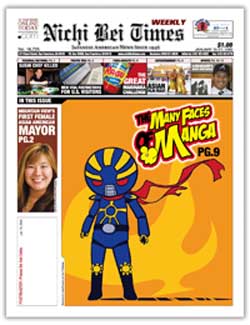
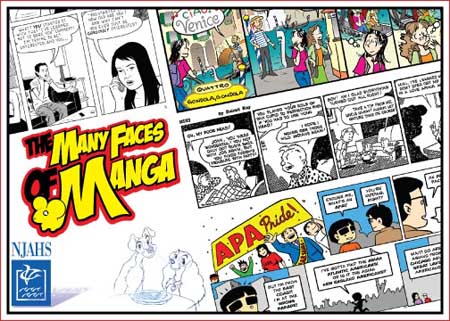
The National Japanese American Historical Society (NJAHS), in collaboration with the Nichi Bei Times, is presenting an exhibit of the ever-popular artform of manga and anime in the heart of San Francisco's Japantown.
Titled "The Many Faces of Manga," the exhibit includes the work of Japanese American and Asian American comic artists from throughout the country, feature stories from the past three Nichi Bei Times Anime and Manga Special Editions, and the winners of the past two Nichi Bei Times Manga Art Contests. It will be held from Saturday, Jan. 10 through Tuesday, June 30 at the NJAHS Gallery, 1684 Post St. (across from the Peace Plaza) in San Francisco's Japantown.
The exhibit is co-curated by Deb Aoki, the manga guide at about.com and creator of the Honolulu Advertiser's "Bento Box," and Nichi Bei Times English Edition Editor Kenji G. Taguma. Additional curation was contributed by Rick Deragon, the director of the Napa Valley Museum.
The exhibit features an Art Wall, where visitors young and old will be able to contribute their own art on a large canvas.
Expanded Exhibit Features Original Artwork
The idea for a manga exhibit was originally conceived when the director of the Napa Valley Museum got wind of the Nichi Bei Times' second annual Manga Art Contest, and then launched a month-long exhibit at the museum in the heart of Wine Country last summer. Since then, forms of the exhibit have ventured to the Spirit of Japantown Festival in San Jose, and then the Shibuya restaurant at the MGM Grand Hotel in Las Vegas.
"Manga is chock full of desirable elements," said Napa Valley Museum Executive Director Rick Deragon. "It's hip, cool, stylish, common, uncommon, mysterious, fantastic, realistic — provocative in so many ways. Manga fulfills people's needs to be entertained in artful ways."
While the original exhibit featured solely digital reproductions of art, "The Many Faces of Manga" will include original works by contributing artists.
Included will be an original copy of Henry Kiyama's pioneering "The Four Immigrants Manga," originally published in 1931 in Japanese to depict the Issei (Japanese immigrant) experience in San Francisco. Also included will be original artwork by former Disney animator Willie Ito, as well as original art by Stan Sakai, creator of the cult favorite "Usagi Yojimbo."
Contemporary illustrators will add their original comic art as well, such as Tak Toyoshima, whose "Secret Asian Man" was the first Asian American lead character to be nationally syndicated, and artist/actress Lela Lee, whose "Angry Little Girls" has developed a strong following for both the comic and the accompanying line of merchandise.
Japanese American illustrators who originated from Hawai'i will also be highlighted, including Aoki, whose "Bento Box" is a featured comic strip in the Honolulu Advertiser, "nemu*nemu" creators Audra Furuichi and Scott Yoshinaga , and "Online Aloha" and Honolulu-Star Bulletin comic artist Jon J. Murakami.
Also featured will be articles about manga master Osamu Tezuka ("Astro Boy"), Adrian Tomine ("Optic Nerve") and pioneer comic strip artist Bob Kuwahara ("Miki"), as well as features on "Anime Goes Hollywood," "Original English Manga" and the "Ghibli Museum."
"We are pleased to present in collaboration with the Nichi Bei Times and the Napa Valley Museum a 'taste' of Japanese and Asian American cartoon artists of the past half-century or so," stated NJAHS Executive Director Rosalyn Tonai. "We invited manga aficionado Deb Aoki and Nichi Bei Times English Edition Editor Kenji G. Taguma to bring together their favorite characters and artists to help us understand our unique Japanese American connection to manga or 'comics' as we know them."
Career-Launching Artwork
Last year marked the second annual Nichi Bei Times Manga Art Contest, which again featured the top four winners in the third annual Nichi Bei Times Anime and Manga Special Edition.
The Manga Art Contest helped to launch the career of at least one contestant.
Since winning first place in the 2007 contest, Tony Foti's career has blossomed from "unrecognizable" to "Hey, I've seen that guy's art," he said. His work has appeared in books, magazines, newspapers and on clothing. The San Jose resident's latest endeavors involve him working on several book covers for a publisher in New York.
"I can't stress enough just how much your contest last year helped launch my career," Foti told the Nichi Bei Times in 2008.
"It's great to see that our Anime and Manga Special Edition actually helped to launch the career of an aspiring artist," said Taguma. "As our mission is to keep the community connected, informed and empowered, it's great to see how we and our judges helped to empower this one talented individual."
The 2008 contest winner was 17-year-old Kimberly Igno of Hercules, Calif.
"I got into [drawing] because of anime and manga," said Igno in an artist statement. "This is the first time I joined something anime/manga related. I would rather pursue something anime/manga related than anything else."
Growth of an Artform
The anime culture, introduced decades ago via old "Speed Racer" cartoons, has changed dramatically, notes Nichi Bei Times contributing writer Tomo Hirai.
"In the mid-1990s, anime culture exploded with the introduction of 'Dragon Ball,' 'Sailor Moon' and 'Pokémon,'" Hirai stated. "With its increase in popularity, the diversity of topics and styles covered within the genre also grows. More and more American artists are taking in these influences from such an atmosphere."
According to Taguma, the Nichi Bei Times Anime and Manga Special Edition has expanded since its first incarnation in 2006. The Nichi Bei Times is perhaps the only newspaper in the country to have an annual dedicated anime and manga edition.
"All of a sudden, we've become a go-to publication for anime and manga," said Taguma. "We're blessed to have dedicated contributing writers who have a firm grasp on the genres."
Coming Full Circle
Co-Curator Deb Aoki sees the exhibit as displaying a circle of influences and inspirations.
"For Japanese American comics and animation artists, mixing the artistic influence of American comics and animation from Disney, Warner Brothers and Hanna-Barbera and anime, manga, TV shows, movies and toys from Japan mirrors our dual cultural heritages," states Aoki in the exhibit introduction. "For artists like Willie Ito and Iwao Takamoto, the dream was to draw for an animation studio like Disney or Warner Brothers, a goal they both achieved successfully."
Meanwhile, Stan Sakai was "inspired by samurai movies, TV shows and comics he enjoyed as a young man," writes Aoki.
"Tak Toyoshima and Lela Lee mix the simplicity of Sanrio-style characters with a voice that's loudly and proudly Asian American. "
Aoki stresses the universal appeal of the genre.
"There's a lot of talk about what is, and what isn't manga," she writes. "My comic strip 'Bento Box' is inspired by manga, but isn't exactly manga as most people would define the style.
"However, in Japan, 'manga' just means comics — and that is what we're presenting here: Manga / Comics by Japanese / Americans that are inspired by Japanese and American styles," she concludes in the exhibit statement. "I hope these works inspire you to create your own comics as much as Tezuka-sensei and Mr. Disney has inspired us."
* * *
NJHAS Gallery hours are from 12 to 5 p.m. Mondays through Fridays, and the first Saturday of the month. Admission to the NJAHS Gallery is FREE (donations gladly accepted). For more information on the exhibit or the National Japanese American Historical Society, call (415) 921-5007 or visit www.njahs.org.

read more

Friday, July 22, 2011

Best New Anime!

Friday, July 22, 2011
0 comments
My day started off with the Production I.G panel. With trailers for the Bunny Drop anime and Blood C, a collaboration with CLAMP and the Blood franchise. While the highlight of the panel is definitely Maki Terishima and her complete  honesty with the crowd, Maki revealed that Yen Press would be giving out lots of copies of Avi Arad’s The Innocent at Comic Con International.
Next up was the Anime Manga Trivia Battle: U.S. Executives vs. Japanese Executives panel. The panelists included Lance Heiskell of FUNimation, Patrick Macias of Crunchyroll/Otaku USA, Michelle Hwang of Crunchyroll, Mikako Ogata of Wowmax Media, Atsushi Yanai of Viz, Ken Iyadomi of Bandai and Henry Goto of Aniplex of America.
Although the title made it seem like it would be a battle of anime and manga knowledge, the panel run by the Japan External Trade Organization (JETRO) was more like an audience feedback section. Interspersed between five or six trivia questions, the attending executives asked the audience their opinions about whether they would want to see classic anime or manga on the market, whether they preferred digital manga to print manga and what kind of online streaming sites they liked. Not only did the audience answer yes or no with signs passed out by JETRO at the beginning of the panel, but the industry folks called upon different audience members to state their opinions on the questions to get more insight into why the audience answered one way or another. There was also a paper survey given out asking about how the audience members bought and consumed anime and manga. While Anime Expo is too small a sampling to base corporate decisions on, I think JETRO and the executives should continue to poll con attendees around the country to see where the broader tastes of the U.S. Market lie. If nothing else, it was fun to interact with the bigwigs and feel like your opinion counts somewhere. Too often, industry panels are only a means to pump out trailers and release dates for new anime and manga hitting the market, so getting to actually share opinions and discuss them with higher-ups felt good.
Atsushi Yanai of Viz also stated that the company is looking to offer their manga app on systems other than the iPhone/iPad, so manga lovers who hate iOS might not be left without Viz’s growing digital manga catalog for much longer.
During the Anime Manga Trivia Battle, there was a suspected bomb threat in the South Hall food court of the convention center. It seems like most of the South Hall corridors and the food court itself were promptly evacuated, but not the Dealer’s Hall.  Anime News Network later reported that the object was an unmarked basket and that it was thankfully nothing serious.
Since the bomb scare didn’t affect anyone in the West Hall, I went on ahead to the Anime News Network panel and then to the Digital Manga Publishing panel. Unfortunately, the Digital Manga Publishing panel focused entirely on the Digital Manga Guild. While they announced the first 23 titles to be sent out for localization through the Digital Manga Guild, the publisher announced no new manga licenses for print.
Here’s the DMG list that I found on Anime News Network:
Tired of Waiting for Love By author Saki Aida and artist Yugi Yamada
Rule of Standing on Tiptoe By Puku Okuyama
Again Tomorrow By Nabako Kamo
Second Night of a Thousand Nights By Keiko Kinoshita
You and Tonight by Keiko Kinoshita
Steadfast Candy Heart Love by Satomi Konno
Neck-Tie by Asahi Shima
I Love Love Too by Himeko Shindo
Only the Flower Knows by Rihito Takarai
My Sempai by Hebiko Habuyama
Courtesan Kings by Souya Himawari
The Reason Why He Loves Him So Much by Saori Mieno
The Faithful Dog Waits for Flowers by Mario Yamada
Chirp Chirp by Kotetsuko Yamamoto
Mad Cinderella by Kotetsuko Yamamoto
Blooming Darling by Kotetsuko Yamamoto
Full Bloom by Rio and Saori Mieno
The Kneeling Butler by Ikue Ishida
The Song of Rainfall by Nawo Inoue
A Passion of Oranges by Ruis Maki
Interval by Kanami Itsuki
Dokidoki Crush by Kotetsuko Yamamoto
Curve by Kahiro Kyouda
While I believe all of these titles are yaoi, Digital Manga Publishing tried to assure the small audience that future titles would not consist solely of BL titles.
Later, at the Bandai Entertainment panel, the company announced the only new print manga licenses of the con thus far, the Gundam 001 and Booboo Kagaboo manga. Meanwhile, they announced that they would be streaming Sacred Seven on Hulu and Crunchyroll starting on July 8th and that The Disappearance of Haruhi Suzumiya movie and Turn A Gundam series would be coming out in the fall.
Unfortunately, that’s it for Day Two! I didn’t go to the Mikunopolis concert, but I heard that those in attendance had a great time.
Industry events for the rest of the convention are few, but perhaps that will give me time to roam the Dealer’s Hall for some great deals on cheap manga!

read more

Wednesday, July 20, 2011

Wednesday, July 20, 2011
0 comments
The National Japanese American Historical Society (NJAHS), in collaboration with the Nichi Bei Times, is presenting an exhibit of the ever-popular artform of manga and anime in the heart of San Francisco's Japantown.
Titled "The Many Faces of Manga," the exhibit includes the work of Japanese American and Asian American comic artists from throughout the country, feature stories from the past three Nichi Bei Times Anime and Manga Special Editions, and the winners of the past two Nichi Bei Times Manga Art Contests. It will be held from Saturday, Jan. 10 through Tuesday, June 30 at the NJAHS Gallery, 1684 Post St. (across from the Peace Plaza) in San Francisco's Japantown.
The exhibit is co-curated by Deb Aoki, the manga guide at about.com and creator of the Honolulu Advertiser's "Bento Box," and Nichi Bei Times English Edition Editor Kenji G. Taguma. Additional curation was contributed by Rick Deragon, the director of the Napa Valley Museum.
The exhibit features an Art Wall, where visitors young and old will be able to contribute their own art on a large canvas.
Expanded Exhibit Features Original Artwork
The idea for a manga exhibit was originally conceived when the director of the Napa Valley Museum got wind of the Nichi Bei Times' second annual Manga Art Contest, and then launched a month-long exhibit at the museum in the heart of Wine Country last summer. Since then, forms of the exhibit have ventured to the Spirit of Japantown Festival in San Jose, and then the Shibuya restaurant at the MGM Grand Hotel in Las Vegas.
"Manga is chock full of desirable elements," said Napa Valley Museum Executive Director Rick Deragon. "It's hip, cool, stylish, common, uncommon, mysterious, fantastic, realistic — provocative in so many ways. Manga fulfills people's needs to be entertained in artful ways."
While the original exhibit featured solely digital reproductions of art, "The Many Faces of Manga" will include original works by contributing artists.
Included will be an original copy of Henry Kiyama's pioneering "The Four Immigrants Manga," originally published in 1931 in Japanese to depict the Issei (Japanese immigrant) experience in San Francisco. Also included will be original artwork by former Disney animator Willie Ito, as well as original art by Stan Sakai, creator of the cult favorite "Usagi Yojimbo."
Contemporary illustrators will add their original comic art as well, such as Tak Toyoshima, whose "Secret Asian Man" was the first Asian American lead character to be nationally syndicated, and artist/actress Lela Lee, whose "Angry Little Girls" has developed a strong following for both the comic and the accompanying line of merchandise.
Japanese American illustrators who originated from Hawai'i will also be highlighted, including Aoki, whose "Bento Box" is a featured comic strip in the Honolulu Advertiser, "nemu*nemu" creators Audra Furuichi and Scott Yoshinaga , and "Online Aloha" and Honolulu-Star Bulletin comic artist Jon J. Murakami.
Also featured will be articles about manga master Osamu Tezuka ("Astro Boy"), Adrian Tomine ("Optic Nerve") and pioneer comic strip artist Bob Kuwahara ("Miki"), as well as features on "Anime Goes Hollywood," "Original English Manga" and the "Ghibli Museum."
"We are pleased to present in collaboration with the Nichi Bei Times and the Napa Valley Museum a 'taste' of Japanese and Asian American cartoon artists of the past half-century or so," stated NJAHS Executive Director Rosalyn Tonai. "We invited manga aficionado Deb Aoki and Nichi Bei Times English Edition Editor Kenji G. Taguma to bring together their favorite characters and artists to help us understand our unique Japanese American connection to manga or 'comics' as we know them."
Career-Launching Artwork
Last year marked the second annual Nichi Bei Times Manga Art Contest, which again featured the top four winners in the third annual Nichi Bei Times Anime and Manga Special Edition.
The Manga Art Contest helped to launch the career of at least one contestant.
Since winning first place in the 2007 contest, Tony Foti's career has blossomed from "unrecognizable" to "Hey, I've seen that guy's art," he said. His work has appeared in books, magazines, newspapers and on clothing. The San Jose resident's latest endeavors involve him working on several book covers for a publisher in New York.
"I can't stress enough just how much your contest last year helped launch my career," Foti told the Nichi Bei Times in 2008.
"It's great to see that our Anime and Manga Special Edition actually helped to launch the career of an aspiring artist," said Taguma. "As our mission is to keep the community connected, informed and empowered, it's great to see how we and our judges helped to empower this one talented individual."
The 2008 contest winner was 17-year-old Kimberly Igno of Hercules, Calif.
"I got into [drawing] because of anime and manga," said Igno in an artist statement. "This is the first time I joined something anime/manga related. I would rather pursue something anime/manga related than anything else."
Growth of an Artform
The anime culture, introduced decades ago via old "Speed Racer" cartoons, has changed dramatically, notes Nichi Bei Times contributing writer Tomo Hirai.
"In the mid-1990s, anime culture exploded with the introduction of 'Dragon Ball,' 'Sailor Moon' and 'Pokémon,'" Hirai stated. "With its increase in popularity, the diversity of topics and styles covered within the genre also grows. More and more American artists are taking in these influences from such an atmosphere."
According to Taguma, the Nichi Bei Times Anime and Manga Special Edition has expanded since its first incarnation in 2006. The Nichi Bei Times is perhaps the only newspaper in the country to have an annual dedicated anime and manga edition.
"All of a sudden, we've become a go-to publication for anime and manga," said Taguma. "We're blessed to have dedicated contributing writers who have a firm grasp on the genres."
Coming Full Circle
Co-Curator Deb Aoki sees the exhibit as displaying a circle of influences and inspirations.
"For Japanese American comics and animation artists, mixing the artistic influence of American comics and animation from Disney, Warner Brothers and Hanna-Barbera and anime, manga, TV shows, movies and toys from Japan mirrors our dual cultural heritages," states Aoki in the exhibit introduction. "For artists like Willie Ito and Iwao Takamoto, the dream was to draw for an animation studio like Disney or Warner Brothers, a goal they both achieved successfully."
Meanwhile, Stan Sakai was "inspired by samurai movies, TV shows and comics he enjoyed as a young man," writes Aoki.
"Tak Toyoshima and Lela Lee mix the simplicity of Sanrio-style characters with a voice that's loudly and proudly Asian American. "
Aoki stresses the universal appeal of the genre.
"There's a lot of talk about what is, and what isn't manga," she writes. "My comic strip 'Bento Box' is inspired by manga, but isn't exactly manga as most people would define the style.
"However, in Japan, 'manga' just means comics — and that is what we're presenting here: Manga / Comics by Japanese / Americans that are inspired by Japanese and American styles," she concludes in the exhibit statement. "I hope these works inspire you to create your own comics as much as Tezuka-sensei and Mr. Disney has inspired us."
* * *
NJHAS Gallery hours are from 12 to 5 p.m. Mondays through Fridays, and the first Saturday of the month. Admission to the NJAHS Gallery is FREE (donations gladly accepted). For more information on the exhibit or the National Japanese American Historical Society, call (415) 921-5007 or visit www.njahs.org.

read more

Thursday, July 14, 2011

What Now, TokyoPop? Fate of Unfinished Manga Series Revealed

Thursday, July 14, 2011
0 comments
When TokyoPop announced that they'd be shutting the doors on their North American manga publishing operations last month, there were a few lingering questions that were left unanswered.
  1. What about the Japanese manga series that were left unfinished?

  2. What about the rights to the original graphic novels that TokyoPop published (and never finished in print), like East Coast Rising by Becky Cloonan, Me2 by Sho Murase and many, many more left in limbo?

  3. What about all the manga that TokyoPop published in the past that's probably in some warehouse somewhere?

Question #3 was answered when TP announced their Garage Sale in early May, and subsequently announced that they'd be holding another blow-out liquidation sale of manga and memorabilia at the AM2 anime con at the Anaheim Convention Center from July 1 - 3, 2011.
Question #2 remains unanswered -- but fans finally got a response to Question #1 on TokyoPop's Facebook page today:
East Coast Rising Vol. 1"Dear Fans:
It's been a while since we've commented on the status of all the titles that are left unfinished or unpublished. Just so you know, we're still reading all of your comments and want to explain a few things."
"Our general absence on Facebook hasn't gone unnoticed, but it's mainly due to the fact that we were looking for answers to all of your questions too! Shutting down a publishing company like TOKYOPOP isn't exactly pulling a plug out of a wall, so please understand that it might take a little bit longer than usual before we get to your questions."
"Secondly, we're very grateful that even in these hard times, our fans still stand behind us. Of course, there are some rants here and there ... but we can't blame you for being emotional; so are we. It means a lot to us to still receive fan mail on a daily base and read all of your comments here in Facebook. It's good to know that even when TOKYOPOP is gone, the community will still remain."
"Thirdly, the unfinished/unpublished titles. What is going to happen to them? To be honest: it's out of our hands now. The licenses belong to the original Japanese creators, so it's up to them what to do with the series. They might pull the plug on some series, or find another publishing company to complete their series. The best thing that you can do is keep supporting the original creators, hoping that they'll here your cries like we did so many years ago."
Hetalia Vol. 2"If you have any questions, we will try to answer as many of them as possible. We're here, we're listening and we're answering ..."
"With love,
TOKYOPOP ♥"
So where does that leave you, fans of unfinished series like Hetalia: Axis Powers, Alice in the Country of Hearts, Gakuen Alice, Deadman Wonderland and much more?
If I'm reading TokyoPop's letter correctly, it's up to you to plead your case with the remaining North American manga publishers to pick up these now up-for-grabs titles, and convince them that it'll be worth their while to pick up their now abandoned titles (e.g. that it'll sell enough copies to justify their investment if they spend the time/money to pick up the license to publish it in English again.)
I posed this question on Twitter, but I'll throw it out there again for posterity:  which unfinished TokyoPop series would you most passionately want to see picked up by another publisher? Many of you tweeted a long list of worthy titles like V.B. Rose, Aria, Silver Diamond, Vassalord, Suppli and Future Diary -- but here's your chance to make your case to your fellow fans, and maybe a publisher or two who are looking for your tips on which former TokyoPop manga series matters most to you. Add your comments below, and let's see where this goes.

read more

Saturday, July 9, 2011

20 Insanely Cool Manga Fonts

Saturday, July 9, 2011
0 comments
It’s hardly surprising that more and more westerners are becoming interested in creating their own manga-style comics: not only is it a rich and varied art form, there’s a lot of money in it too. The manga market is worth $4.4 billion a year in Japan alone and a further $200 million in the USA.
If you want to create your own manga, you’re going to need the right manga fonts, or your work’s going to stick out like a Mickey Mouse cartoon at a dojinshi convention. Fear not, you can choose from any one of the brilliant fonts listed below. Use an all-caps font for your main text, a handwritten font for small text, and a variety of different fonts for sound effects. One last word of advice: avoid Comic Sans at all costs (die-hard manga fans hate it above all else.)
Wild Words
1. Wild Words Wild Words, originally created for Jim Lee’s Wildstorm books, has almost become the industry standard font for translated manga text (as opposed to sound effects). It has even been featured in TIME magazine.
Anime Ace
2. Anime Ace Anime Ace, by Blambot, would have to be the second most popular font used in translated manga text, after Wild Words.
Manga
3. Manga Simply called Manga, this font by Neale Davidson is a little obvious and over-stylised perhaps, but it’s effective nonetheless when used as a title.
Manga Speak
4. Manga Speak As the name suggests, this font designed by Teabeer Studios is ideal for speech. The font was originally used in Shonen Punk comics, which have a clear manga influence.
Saiyan Sans
5. Saiyan Sans Ben Palmer designed this bold font, which looks best when it’s in a big size.
Ninja Naruto
6. Ninja Naruto This ghoulish, spooky looking font was designed by sk89q in 2004 and remains a firm favourite among mangaka (manga artists).
Poekmon
7. Pokemon This is the famous Pokemon font from the video game, manga, anime, trading card, book and toy franchise, created by Satoshi Tajiri in 1995.
Nikona
8. Nikona Inspired by Asimov’s three robotic laws, this font family is perfect for use in any manga featuring robots or mutants. Carlos Fabi·n Camargo Guerrero and Rafael RincÛn designed it.
Zaius
9. Zaius Ed Benguiat’s legendary work has inspired many a typographer, including Jonathon Hill and his Zaius font. Zaius is perfect for all sci-fi, interplanetary manga.
Sky Wing
10. Sky Wing Yet another Jonathon Hill font, this time inspired by vintage Japanese computer games.


GetaRobo
11. GetaRobo The third and final Jonathon Hill font in this list, GetaRobo is reminiscent of Japanese anime, including Getter Robo and Gatchaman.
Manga Temple
12. Manga Temple Another very popular manga font, this time by Blambot, Manga Temple is very easy to read across a range of sizes.
Tokyo Robot BB
13. Tokyo Robot BB Tokyo Robot BB was designed by Nate Piekos to accompany all types of manga art, but especially that to do with big robots.
Augie
14. Augie According to Steven J. Lunden, who designed this font, Augie was based on the handwritten class notes of a ìsolid B-minus studentî. It has since become ëde rigueur’ to use it in western manga-style comics.
Another
15. Another Another, a font by UnAuthourized Type, is perfect for use in manga sound effects.
Big Fish Ensemble
16. Big Fish Ensemble The band Big Fish Ensemble received the ultimate honour when they had this font named after them. It’s based on the handwritten letters that appeared on their album ìPlayî. It works really well for manga sound effects, especially ëscratchy’ and ëspiky’ sounds, thanks to its pointed structure.
Trash Hand
17. Trash Hand This font by Luce AvÈrous is simple and very effective in that it’s crystal clear, but also quite compact.
VNI-HLThuphap
18. VNI-HLThuphap Not a very catchy name, but a great font nonetheless. Its simulated brush-strokes have a classic, gothic look.
Scott McCloud Complete Family Pack
19. Scott McCloud Complete Family Pack At a price of around $70, this isn’t the cheapest font on the market, but thanks to its clarity, it’s one of the best for use in comic books of all types, including manga.
Felt Regular
20. Felt Regular Felt Regular is a handwritten font with a certain childlike quality, which makes it suitable for use in manga with a childhood theme.

read more

Friday, July 1, 2011

Japan, Ink: Inside the Manga Industrial Complex

Friday, July 1, 2011
0 comments

When the chimes sound at 10:30 am, the young men pour through the doors. First a few dozen. Then a few hundred. Then, in a matter of minutes, a few thousand. Mobile phones pressed to their ears, empty backpacks flapping on their skinny shoulders, they tear across the floor of the Tokyo Big Sight convention center as if pursued by demons.
"Hashiranaide!" cry the blue-shirted security officials. "Hashiranaide!" Don't run! But it's no use. The collective force of so many men fed on a combo platter of anticipation and desire is unstoppable. Call it the running of the otaku. For what has stoked their fires isn't flesh or cash but stack upon precious stack of manga.
As you may have noticed, Japanese comics have gripped the global imagination. Manga sales in the US have tripled in the past four years. Titles like Fruits Basket, Naruto, and Death Note have become fixtures on American best-seller lists. Walk into your local bookstore this afternoon and chances are the manga section is bigger than the science fiction collection. Europe has caught the bug, too. In the United Kingdom, the Catholic Church is using manga to recruit new priests. One British publisher, in an effort to hippify a national franchise, has begun issuing manga versions of Shakespeare's plays, including a Romeo and Juliet that reimagines the Montagues and Capulets as rival yakuza families in Tokyo.
Yet in Japan, its birthplace and epicenter, manga's fortunes are sagging. Circulation of the country's weekly comic magazines, the essential entry point for any manga series, has fallen by about half over the last decade. Young people are turning their attention away from the printed page and toward the tiny screens on their mobile phones.
Fans and critics complain that manga — which emerged in the years after World War II as an edgy, uniquely Japanese art form — has become as homogenized and risk-averse as the limpest Hollywood blockbuster. Pervading the nation's $4.2 billion-a-year industry is a sense that its best days have passed.
Wired art director Carl DeTorres discusses the evolution of the manga cover for the November issue.
For more, visit wired.com/video.
Which ought to make what's happening here at Comic Ichi — a manga market the size of several airplane hangars that will attract some 25,000 buyers — so heartening. The place is pulsing with possibility, full of inspired creators, ravenous fans, and wads of yen changing hands. It represents a dynamic force that could reverse the industry's decline.
There's just one hitch, one teensy roadblock on the manga industry's highway to rejuvenation: Nearly everybody here is breaking the law.
This spring I spent two months in Japan looking under the hood of the manga industry. I met with key players in the supply chain — from the artists who create the work and the editors who polish it to the retailers who sell it and the fans who devour it. I argued with manga critics in Tokyo, hung out at the country's only college manga department in Kyoto, and paid homage to the God of manga in Osaka. I was hoping to get a sense of why Japanese comics have become so insanely popular around the world. What I got instead was a tantalizing peek into what might be the future business model of music, movies, and media of every kind.

Manga isn't just for freaks and geeks. Ride the Tokyo subway and you'll see graying salarymen, twentysomething hipsters, and schoolgirls all paging through a manga weekly or a graphic novel.
Photo: Ofer Wolberger
To understand manga's place in Japan, you must begin with its ubiquity. Even though the popularity of manga has fallen in recent years, it still comprises about 22percent of all printed material in Japan. In many parts of Tokyo, you can't walk more than two or three blocks without encountering comics. (Trust me. I checked.) Most omnipresent are the magazines — Weekly Shonen Magazine, Weekly Shonen Jump, Young King Ours, Shojo Comic, and countless others. They're teetering in messy piles at convenience stores, stacked in neat slabs at every subway station, and for sale just about anywhere someone might be inclined to pull a couple hundred yen ($2 to $4) from their pocket. Published on flimsy newsprint and often as thick as a Baltimore phone book, these magazines can contain 25 different serialized stories that run about 20 pages each. The most popular series then get repackaged as paperback graphic novels. These books dominate long stretches of Japanese bookstores, and their sales figures would make American authors and publishers weep with envy. One example among many: The paperback editions of Bleach, a series about a ghost-spotting teenager that has been running in Weekly Shonen Jump for the past six years, have sold some 46 million copies (in a country of 127 million people).
And manga, unlike most American comics, isn't reserved for freaks, geeks, and pip-squeaks. Ride the Tokyo subway and you'll see passengers peering at their mobiles. But you'll also inevitably spot gray-haired businessmen, twentysomething hipsters, and Japanese schoolgirls alike paging through a manga weekly or a graphic novel. The city of Hiroshima even has a bustling public library devoted entirely to manga.
Yet the role of manga in the broader economic ecosystem is perhaps more important than its actual sales figures. Japan's vaunted pop culture apparatus, it turns out, is really a manga industrial complex. Nearly every aspect of cultural production — which is now Japan's most influential export — is rooted in manga. Most anime (animated) movies and television series, as well as many videogames and collectible figures, began life as comics. Dragonball — now a multibillion-dollar international franchise comprising movies, games, and cards — debuted as an installment in Weekly Shonen Jump in 1984. Uzumaki Naruto, the protagonist of the mega-property that bears his name, first showed his blond ninja head in the pages of the same magazine eight years ago. Trace any of Japan's most successful media franchises back to their origins and you'll likely end up inside a colorful brick of newsprint, where 20 pages of exquisitely matched words and drawings tell the inaugural story.
But manga has become a bit like network television in the US. It reaches a wide but inexorably shrinking audience. Weekly magazine circulation is on a steep and steady downward slope; book sales are no higher than they were a decade ago despite a rise in population. Still, manga is more influential in Japan than network television is in the US. Comics occupy the center, feeding the rest of the media system. If they dry up, other media players risk losing their deepest and most vital source of material. If manga gets creaky, and by all accounts it is heading that way, it could undermine Japan's entire pop culture machine. What the industry needs is something that can rescue it from decline — a force that can reenergize its fans, restock its talent pools, and revive its creative mojo. The sound of those flapping backpacks may herald the arrival of that savior.

Amateur manga artists routinely remix characters and situations created by the pros (inset).
Photo: Ofer Wolberger
A few days after visiting Comic Ichi, I returned to Tokyo Big Sight for Super Comic City, another manga market, this one held over two days to accommodate even larger crowds. Although Comic Ichi was from Mars — the male-to-female ratio, by my rough count, was about 300 to 1 — and Super Comic City was from Venus, with several hundred women for every man, both markets were selling material from the same planet: nonprofessional self-published manga known as dojinshi. At Super Comic City, for instance, 33,000 amateur artists stuffed themselves into six huge halls, each the size of a professional basketball arena, stationed themselves behind card tables, and sold their own home-brewed comics.
Markets like these started to appear in 1975, when a few hundred fans with an artistic bent gathered to trade their work. Today, dojinshi has become a sprawling enterprise. The comics markets — comikets, for short — held in December and August attract about a half-million people. Most of the material for sale at those markets, as well as the ones I visited, have the look and feel of professional work. Their creators often spend weeks meticulously drawing and inking their comics. Then they typically scan those pages onto computers and refine them with Photoshop and other software. Finally, using one of an array of print shops that cater to dojinshi, they produce limited editions of the work (as few as 20 copies, as many as several thousand) on high-quality paper, bound between glossy covers.
I spent two days at Super Comic City. But an American intellectual property lawyer probably would not have lasted more than 15minutes. After cruising just one or two aisles, he would have thudded to the floor in a dead faint. About 90 percent of the material for sale — how to put this — borrows liberally from existing works. Actually, let me be blunter: The copyright violations are flagrant, shameless, and widespread. For example, in both Japan and the US, one of the past decade's most successful manga series is Fullmetal Alchemist. The story pivots around a group of people with the ability to transmute matter into new substances. The main character is Edward Elric, a young man who possesses these powers. Another character is a father-figure type named Colonel Roy Mustang. At Super Comic City, there were at least 30 tables where amateurs were selling 20- or 30-page stories in which perfectly drawn, instantly recognizable Elrics and Mustangs discover their forbidden love for each other. (In all, 1,100 Full Metal Alchemist dojinshi groups had registered to sell their wares.) In many of these comics, the drawings are so precisely rendered that the characters are indistinguishable from the originals. Some of these tales portray chaste affairs full of yearning and unrealized passion. Others depict sexual encounters grunting and graphic enough to make Larry Flynt blush. Though nobody was merely reproducing existing Fullmetal Alchemist stories, everybody — by swiping the characters without consent and selling the resulting work to others — was trampling intellectual property rights. And Japanese copyright law is just as restrictive as its American cousin, if not more so.
It was the same everywhere I went: acres of territory in which the basic tenets of intellectual property seemed not to apply. True, some dojinshi collectives, which are known as "circles" even if they have only one member, were selling works based on their own original characters. At Comic Ichi, one of the longest lines was for drawings of a rabbit-eared maid created by Ice and Choco, a circle made up of one woman named Naru Nanao. But most offerings plucked characters from popular manga series and dropped them into new scenarios. The authors told me they were uncovering hidden potential in their favorite stories — revealing themes, relationships, and plot lines that were gurgling just beneath the surface of the official narrative.
At the edge of one hall, I saw a young woman wearing a short skirt, white shoes, and stylish blue leggings pulled over her knees. She was sitting on a folding chair behind a card table greeting a modest but steady stream of customers. She is 24 years old and lives with her parents in the Kyushu region of southern Japan, about 500 miles away. She works at a bank. "It's a lame job," she said with one of her frequent giggles, "which is why I'm spending my life drawing these comics." Nobody at work or at home knows about her hobby; her parents think she came to Tokyo to visit friends. Because of that, she asked me to use only the first letter of her last name.
Three years ago Ms. O produced her first work, a story about Chibi Maruko-Chan, a sassy third grader — think Sally from Peanuts inflected with Lisa Simpson — who's a mainstay in a long-running kids' series. Since then, she has created nine more short books that reveal what happens in the alternative universe where the series characters actually age. Much of Ms. O's oeuvre concerns an up-and-down love affair between a late-teen version of Chibi Maruko-Chan and another character. "It's so bizarre that Chibi Maruko could be grown up and think about women's things in the first place," she told me. "But we all know deep in her heart that she longs for this." Does Ms. O aspire to be a professional manga artist? "No. I'm happy just to draw." Is she making lots of money? "I don't make any money." What's driving her? "Nobody else is doing this. I had to show this aspect of Chibi Maruko and get it out there."
Guided by a 440-page catalog with tiny blurbs about each circle, buyers — many of them pulling wheeled suitcases — could find all manner of reimagined, copyright-defying manga peddled by people like Ms. O. Yaoi, or "boys' love," was popular among women. Hetero porn remixes were popular among the men. And although sex and romance titles predominated, buyers could also choose from action, adventure, supernatural, and other genres, most selling for 500 to 1,000 yen (about $4 to $8) apiece.
Now think back to our American lawyer — the one lying on the cement floor. After the smelling salts arrived, he no doubt would have picked himself off the ground, thumbed a cease-and-desist letter on his BlackBerry, and phoned in a temporary injunction to close down the joint. Imagine Disney's response if some huge comics convention in St. Louis or Houston were selling exquisitely rendered, easily identifiable comic book versions of Mickey Mouse and Goofy falling in love. Picture the legal department at United Feature Syndicate hearing about someone selling $6 books that show a buxom teenage Sally and a husky teenage Linus canoodling on a beach. The violations at Super Comic City were so brazen and the scale so huge — by day's end, some 300,000 books sold in cash transactions totaling more than $1 million — that just about any US media company would have launched a full-metal lawsuit to shut the market for good.
Why aren't Japanese publishers doing the same? I posed that question to two of the main organizers of Japan's dojinshi gatherings, Kouichi Ichikawa and Keiji Takeda.
"Obviously, there are copyright issues at play here," Ichikawa said. When the markets expanded beyond the clutch of early adopters in the 1980s and 1990s, publishers and authors made threatening noises, and some accused successful dojinshi circles of violating copyright law. But lately, as the markets have reached such enormous scale, the big publishing houses have taken a different approach.
"This is something that satisfies the fans," Ichikawa said. "The publishers understand that this does not diminish the sales of the original product but may increase them. So they don't come down here and shut it down."
"Is that something publishers have told you?" I asked.
No, he said, not exactly. "This is something very Japanese. It's an ancient sensibility — like the wabi-sabi of the tea ceremony."
In case you missed the wabi-sabi lecture back in high school, it means something like "aesthetic transience." I asked Takeda about it.
As recently as a decade ago, he told me, creators of popular commercial works sometimes cracked down on their dojinshi counterparts at Super Comic City. "But these days," he said, "you don't really hear about that many publishers stopping them."
"Why not?" I asked.
They have an understanding, he said, using a phrase I'd encounter again and again: anmoku no ryokai, meaning essentially "unspoken, implicit agreement."
"The dojinshi are creating a market base, and that market base is naturally drawn to the original work," he said. Then, gesturing to the convention floor, he added, "This is where we're finding the next generation of authors. The publishers understand the value of not destroying that." And as the manga weeklies falter and decline, new talent is more important than ever. Meanwhile, Takeda said, the dojinshi creators honor their part of this silent pact. They tacitly agree not to go too far — to produce work only in limited editions and to avoid selling so many copies that they risk cannibalizing the market for original works.
"Obviously," Takeda said, "this is something that no one comes out with a bullhorn and states."
What's less obvious is that anmoku no ryokai isn't just a deft way to avoid conflict. It's also a business model, one that's exportable to the US.
If you want to snag your own little piece of Japanese cool, come to Mandarake. This chain of 11 retail stores sells tons (literally) of used artifacts — manga, trading cards, figures, games, posters, costumes, and dojinshi — that can satisfy the deepest pop culture urges. At the helm of Mandarake is its founder, a failed manga artist named Masuzo Furukawa. By Japanese standards, Furukawa is an iconoclast. His black hair is kinked into curls and colored brownish red. He wears a shiny tracksuit rather than a salaryman's coat and tie. He jokes about his many failures. He opened Mandarake 27 years ago, well before the dojinshi markets began growing more popular — in part to provide another sales channel for the work coming out of them.
At first, publishers were none too pleased with his new venture. "You think I didn't hear from them?" he tells me in a company conference room. But in the past five years, he says, as the scale and reach of the markets has expanded, the publishers' attitude "has changed 180 degrees." It's all a matter of business, he says.
To illustrate what he means, he reaches across the conference-room table and takes my notebook. On a blank page he draws a large triangle. "You have the authors up there at this tiny little tip at the top. And at the bottom," he says, drawing a line just above the widening base of the triangle, "you have the readers. The dojin artists are the ones connecting them in the middle."
In other words, where there was once a clear divide between producers and consumers and between pros and amateurs, the boundaries are now murky. The people selling their wares at the comics markets are consumers and producers, amateurs and pros. They nourish both the top and the bottom. If publishers were to squash the emerging middle, they would disrupt, and perhaps destroy, this delicate new triangular ecosystem. And remember: If manga craters, it could drag the entire Japanese pop culture industry down with it.
However, because permitting — let alone encouraging — dojinshi runs afoul of copyright law, the agreement remains implicit: The publishers avert their eyes, and the dojinshi creators resist going too far. This anmoku no ryokai business model helps rescue the manga industrial complex in at least three ways.
First, and most obviously, it's a customer care program. The dojinshi devotees are manga's fiercest fans. "We're not denying the viability or importance of intellectual property," says Kazuhiko Torishima, an executive at the publishing behemoth Shueisha. "But when the numbers speak, you have to listen."
Second, as Takeda put it at Super Comic City, "this is the soil for new talent." While most dojinshi creators have no aspirations to become manga superstars, several artists have used the comic markets to springboard into mainstream success. The best example is Clamp, which began as a circle of a dozen college women selling self-published work at comics markets in the Kansai region. Today, Clamp's members are manga rock stars; they have sold close to 100 million books worldwide.
Third, the anmoku no ryokai arrangement provides publishers with extremely cheap market research. To learn what's hot and what's not, a media company could spend lots of money commissioning polls and conducting focus groups. Or for a few bucks it could buy a Super Comic City catalog and spend two days watching 96,000 of its best customers browse, gossip, and buy in real time. These settings often provide early warnings of the shifting fan zeitgeist. For instance, a few years ago several circles that had been creating dojinshi for the series Prince of Tennis switched to Bleach, an indication that one title was falling out of favor and another was on the rise. "The publishers are seeing the market in action," Ichikawa says. "They're seeing the successes and the failures. They're seeing the trends."
Taking care of customers. Finding new talent. Getting free market research. That's a pretty potent trio of advantages for any business. Trouble is, to derive these advantages the manga industry must ignore the law. And this is where it gets weird. Unlike, say, an industrial company that might increase profits if it skirts environmental regulations imposed to safeguard the public interest, the manga industrial complex is ignoring a law designed to protect its own commercial interests.
This odd situation exposes the conflict between what Stanford law professor (and Wired contributor) Lawrence Lessig calls the "read only" culture and the "read/write" culture. Intellectual property laws were crafted for a read-only culture. They prohibit me from running an issue of Captain America through a Xerox DocuColor machine and selling copies on the street. The moral and business logic of this sort of restriction is unassailable. By merely photocopying someone else's work, I'm not creating anything new. And my cheap reproductions would be unfairly harming the commercial interests of Marvel Comics.
But as Lessig and others have argued, and as the dojinshi markets amply confirm, that same copyright regime can be inadequate, and even detrimental, in a read/write culture. Amateur manga remixers aren't merely replicating someone else's work. They're creating something original. And in doing so, they may well be helping, not hindering, the commercial interests of the copyright holders. Yet they're treated no differently from me and my hypothetical Captain America photocopies. The result is a misalignment between the emerging imperatives of smart business and the lagging sensibilities of old laws.
How to bring matters into alignment, without undercutting the "read only" protections, has been a vexing issue for American music producers and music studios as well as platforms like YouTube. One possibility, of course, is to change copyright law to make it flexible enough for a read/write culture. Good luck. In the past few decades, the copyright winds in the US have been blowing in the opposite direction — toward longer and stricter protections. It is hard to imagine Hollywood, Nashville, and New York agreeing to scale back legal protection in order to release the creative impulses of super-empowered fans, when the gains from doing so are for now only theoretical.
Another possibility is something akin to Lessig's Creative Commons licenses. Copyright holders could voluntarily reserve only some of their rights or perhaps create a special dojinshi license that allows fans to reproduce and remix works in limited ways. That's probably the ideal option. And perhaps some day Big Media will see its virtues. But the use of Creative Commons licenses so far has been extremely limited. Again, it's difficult to envision large publishers or giant movie and music studios relinquishing control over their products when the benefits are indirect, distant, and as yet unproven.
In anmoku no ryokai, manga publishers might have found a tentative, imperfect, but ultimately more promising answer — a business model that could help media companies in both Japan and the US begin to navigate these potentially treacherous new waters. Instead of rewriting a national statute or hashing out separate individual contracts or crafting special licenses, it leaves everything unsaid in order to simply give the new arrangement a test drive. It takes the situation out of the realm of law and plops it into the realm of economics and game theory. It places the established publishers and the dojinshi creators in something resembling the prisoners' dilemma: If they cooperate — that is, if they honor the terms of anmoku no ryokai — they both gain. But if one overreaches — if publishers crack down aggressively or if dojinshi creators go too far — they both suffer.
Instead of negotiating a formal pact, both parties can advance their interests through the deterrent of mutually assured destruction. What that accommodation lacks in legal clarity, it makes up for in commercial pragmatism. If the experiment fails, then everyone reverts back to the legal status quo. But if it endures, and if everyone comes to realize that the interests of the copyright holders and the fans are aligned, it could become the prelude to wider adoption of Creative Commonsstyle licenses and a more coherent set of rules for a remix culture around the world.
One afternoon in May, I walked into K-Books, a third-floor bookshop in Akihabara, a neighborhood of flashing lights and moving bodies that is the epicenter of Tokyo's otaku culture. In one section of the store, I found graphic novels by Clamp, that circle of women who went from amateurs to best-selling pros. I bought a copy of Chobits, their series about a young man who has a friendly female android assistant; a volume of xxxHolic, about a high school student who works for a witch (despite the trio of x's in the title, it's not porn); and a hardcover edition of Card Captor Sakura, about a girl with magical powers. And in a nearby section of the store, I bought dojinshi versions of those same titles. For 210 yen ($1.80), I picked up Hacker Chobits, in which the female android expands the frontiers of "friendliness." For 630 yen ($5.40) I bought a yuri, or lesbian, version of xxxHolic featuring the two main female characters of that series. And for another 630 yen, I purchased the 70-page, sprightly illustrated Sakura Remix, wherein the heroine encounters a strangely amorous frog and later discovers a hidden video camera in her classroom at an especially inopportune moment.
The official versions and the remixed versions weren't side by side. But they were for sale perhaps 10 yards away from each other. In the same store. Think about that in a US context. You walk in to Barnes & Noble and walk out with a copy of Harry Potter and the Deathly Hallows — as well as an unauthorized remix of a May-December romance between Hermione Granger and Professor Minerva McGonagall. Our American IP lawyer is starting to get woozy again.
A few weeks later, I tossed these books into my backpack, hopped on a train to the outskirts of Tokyo, and entered a castlelike building that is the headquarters of Clamp's media empire. There I met with Ageha Ohkawa, the very smart and refreshingly down-to-earth head of this monumentally successful manga machine. In the late 1980s, before they started to create original work, she and her colleagues produced some remixed versions of Captain Tsubasa, a series about a soccer team, and sold them at dojinshi markets. Today, she's on the other end of the anmoku no ryokai détente.
During our conversation, I reached into my backpack to show her the three Clamp dojin titles I'd bought at K-Books. Her handlers — a few managers and a guy from legal — winced and exchanged worried looks. But Ohkawa burst into a delighted laugh and then flipped through Sakura Remix and Hacker Chobits. "Any popular manga is going to have this treatment done," she told me. "It is by people who are truly in love with the work, and you have to respect that."
So, I asked, is Hacker Chobits actually good for the real Chobits?
She paused. "I think it's good because they are expressing love for the work. And, of course, we come from the dojinshi world, so I understand this." Fans even sometimes send her their dojinshi, and what she admires about these works is the dedication and the innovation they show. "There is originality here. There are new stories. It's not a copy."
Still, she's not entirely comfortable having the black-and-white world of manga governed by the gray zone of anmoku no ryokai. "It's very vague," she says. "It's always pushing the edge of whether it should be forbidden. Should someone actually make a pirate version instead of a remix, this whole thing could collapse." Yet she can't think of a better approach. Holding up a copy of Hacker Chobits, she says, "It's not something I'm going to stand up and rail against."
The manga industrial complex has seen the future. And it works. For now.

read more